Niqavorelocet
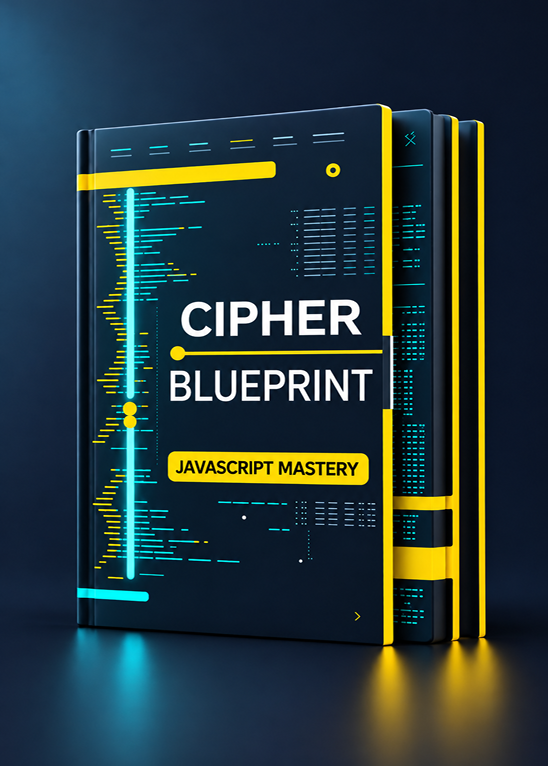
Cipher Blueprint
Cipher Blueprint
Couldn't load pickup availability
- ⬇️ Digital file available after purchase
- 🔄 Long-term availability
- 🔒 Secure checkout
- 🗓️ Content updated in 2026
Self-paced learning overview
Problem Statement
Developing JavaScript applications with multiple connected features introduces challenges in code organization and data management. Learners may struggle to separate responsibilities between modules while maintaining clear communication across components. Asynchronous operations can create unexpected behavior when execution order and error handling are not carefully considered. Managing shared information becomes more demanding as application structures expand. These challenges highlight the importance of studying modular architecture, data flow, and systematic testing techniques.
Solution
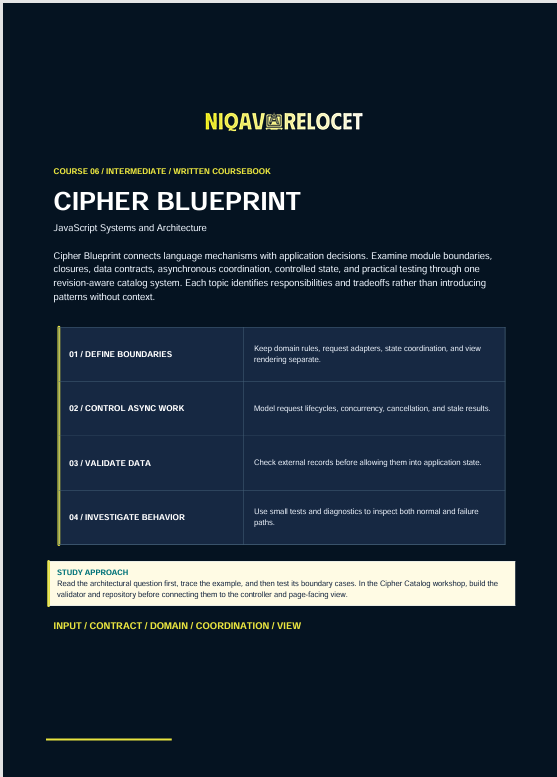
Cipher Blueprint introduces intermediate JavaScript development through structured explanations and connected programming examples. Each module explores a specific architectural concept and demonstrates its application within a larger code structure. Learners examine techniques for separating responsibilities, managing asynchronous workflows, and organizing reusable functionality. Practical exercises illustrate how components exchange information while maintaining readable code. Additional activities introduce testing methods and techniques for evaluating application behavior.
What's Inside
Module 1 — JavaScript Architecture Principles
Explore separation of responsibilities, module boundaries, and the organization of connected application components.
Module 2 — Advanced Function Patterns
Study closures, higher-order functions, callback composition, and reusable programming structures.
Module 3 — Asynchronous Workflow Coordination
Examine promise chains, concurrent operations, asynchronous error handling, and execution order.
Module 4 — Data Communication and Requests
Explore HTTP requests, structured responses, response validation, and introductory network error handling.
Module 5 — State Management Patterns
Study centralized state structures, controlled updates, and communication between interface components.
Module 6 — Testing and Code Evaluation
Learn introductory unit testing concepts, assertions, test cases, and methods for examining function behavior.
Module 7 — Applied Architecture Project
Examine a modular information-management application combining asynchronous requests, reusable functions, state updates, and structured error handling.
Who Is This For?
Cipher Blueprint is intended for learners familiar with JavaScript data structures, asynchronous functions, event handling, and modular programming.
It is not intended for individuals beginning their first programming course.
What You'll Learn
- Organize JavaScript applications into connected modules.
- Apply closures and higher-order functions.
- Coordinate asynchronous operations and handle errors.
- Process network requests and structured responses.
- Manage shared application state.
- Write introductory unit tests and assertions.
- Evaluate code organization and component responsibilities.
Guarantee
14-Day Money-Back: Refund requests may be submitted within 14 days of purchase, subject to the store's published refund policy.
Risk-Free: Learners can review course information before purchasing. Refund eligibility follows the applicable policy conditions.
Certification
The course includes a certificate of completion, providing learners with a document to record their progress and completion of the JavaScript learning activities.
Share
Do I need previous programming experience?
Do I need previous programming experience?
Not necessarily. Our course collection covers different learning stages, from introductory JavaScript concepts to more detailed programming techniques. Each course description explains its intended audience and recommended background knowledge.
What format are the courses provided in?
What format are the courses provided in?
Our JavaScript courses are presented as written educational materials with structured modules, explanations, code examples, and practical exercises. Each tier focuses on particular programming concepts and learning activities.